[CASE STUDY]
Finance App Rescue: Zero to MVP in 2 Weeks
In the high-stakes world of enterprise finance, a stalled deadline isn't just an inconvenience; it's a massive commercial risk.
Recently, a multi-billion-dollar global finance and superannuation company faced a critical cliff-edge. An acquisition was underway, new customers were onboarding to their white-labelled solution, and their mobile technology stack had just hit a wall.
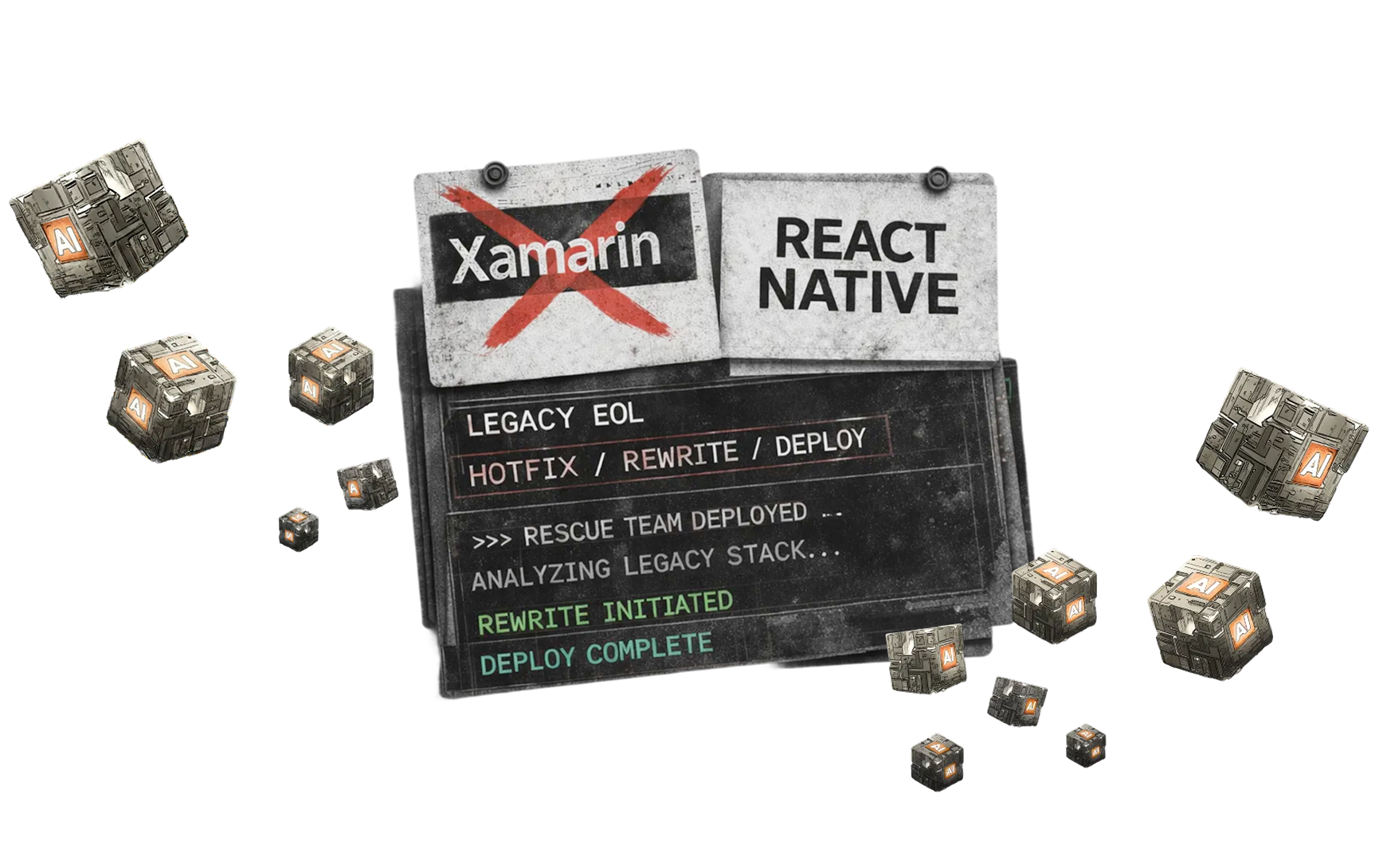
They were running legacy Xamarin applications. Support had ended, and the App Stores were rejecting new deployments. For over three months, their internal team had been attempting a refactor migration to .NET MAUI with no clear delivery date.
They needed a working solution in two weeks.
Patient Zero was deployed as a "Black Ops" Rescue Project team. Our mandate: stop the bleeding, rethink the strategy, and deliver a production-ready MVP before the deadline.
KEY STATS
- 2 Weeks to MVP
- 4 Mobile Apps
- 31 Total Pages Built Per App
- 493 PRs 640 Tests Automated
- 12 Weeks to Complete
- WCAG 2.1 AA Compliant

Ruthless Product Management: The "Black Ops" Strategy
Speed didn't come just from writing code faster; it came from scoping smarter.
We applied a Product Management lens, executing ruthless prioritisation to separate "Must Haves" from "Nice to Haves." Instead of trying to rebuild the entire application parity-for-parity immediately, we architected a strategic Hybrid MVP:
- Key Critical Screens: We identified the high-value flows (Login, Dashboard, Biometrics) and built them as robust, native experiences.
- The Web Bridge: For all secondary screens, we seamlessly linked users to the responsive web version.
This product decision was the game-changer. It allowed us to have a clean, compliant, and reviewable app submitted to the App Store within 2 weeks. It unblocked the new customer acquisition immediately, buying us time to finish the full native build in the subsequent sprints.
The Tech Strategy: Rewrite, Don't Refactor
While the product team managed scope, the engineering team made a critical pivot. The client’s internal team was stuck in a "Porting" trap, trying to lift-and-shift legacy Xamarin code into .NET MAUI.
We halted the refactor and initiated a complete App Modernisation rewrite. While counter-intuitive to "start over" with only weeks on the clock, a clean slate allowed us to:
- Shed Legacy Debt: We abandoned years of "spaghetti code."
- Focus on Logic:
We weren't fighting old bugs; we were building new value.
TECH STACK
- Language: TypeScript
- Frameworks: React Native (iOS & Android), Biometrics, Okta
- Testing: Jest, Screen Readers (Accessibility)
- CI/CD: Azure DevOps
Strategic Migration: Why We Chose React Native over .NET MAUI
The client's original plan to use
.NET MAUI was based on perceived safety ("It's what we know"). We strategically challenged this. We pivoted the stack to React Native. This was a commercial decision based on Future-Proofing and
Market Reality:
Talent Density
The market for React Native developers is vast. The pool for MAUI is shrinking. By choosing React Native, we ensured the client could easily hire internal staff to maintain the app later.
Ecosystem Maturity
React Native is the industry standard for cross-platform, offering stability that niche frameworks struggle to match.
Business Resilience
Picking an obscure tech stack creates "Key Person Risk." Picking the market standard is an insurance policy for your roadmap.
The Accelerator: AI-Assisted Engineering
How do you rewrite an enterprise app in weeks? You use AI-Assisted Engineering.
We deployed an AI-first workflow, utilising Cursor and Figma-to-Code generation to handle the heavy lifting. This allowed our engineers to operate at 10x velocity.
- Boilerplate is Dead: AI generated the UI components instantly from the designs. This allowed a lean team of just three developers to deliver 31 unique screens per app, a volume of work that would typically bury a team twice the size.
- Logic is King: With pixel-pushing automation, our engineers focused purely on complex business logic, biometric security, and clean architecture.
This is the future of Project Rescue. We didn't throw more people at the problem; we threw better tools at it.
The Outcome: 4 Apps, 12 Weeks, Clean Architecture
Within just 12 weeks, the project was complete. We delivered 4 separate apps across 2 brands for both iOS and Android, serving hundreds of thousands of users.
- White-Label Architecture: Built as a modular framework, allowing the client to apply different branding and feature sets to new instances
- Enhanced Security: Introduced Biometric Login (FaceID/Fingerprint) and Okta integration.
- Inclusive Design: Uplifted to
WCAG AA Accessibility Standards, verified via screen readers.
The Quality Reality
A common fear in rescue projects is that "quality must drop to move fast." Our data proves the opposite. By Sprint 1, our small team (1 Product Owner, 3 Developers) had submitted 92 Pull Requests and written 115 Automated Tests.
We moved faster because we had high quality, not in spite of it. Automated compatibility testing (via
Playwright) meant we never had to slow down to fix regression bugs.
Modernise Without the Risk
You don't have to accept stalled timelines as "business as usual." Whether you need to rescue a failing migration or build a new product at 'Start-Up Speed' within an enterprise, we have the specialised teams to get it done.
- Project Rescue: Stalled migration? See how we turn it around.
- Mobile Apps: Explore our React Native capabilities.
- Product Strategy:
Learn about our ruthless prioritisation techniques.