GITEX Global Review: The Robots Are Here (And Australia Isn't)
If you haven’t heard of GITEX Global before, don’t worry, neither had I until about a year ago when their digital advertising game levelled up and plastered itself across all 50 of my browser tabs.
Turns out GITEX is a big deal. Originally starting in 1981 as the Gulf Computer Exhibition (GCE), it has since grown to be one of the world’s largest tech and innovation shows, now sitting third globally behind CES Las Vegas and the Mobile World Congress (MWC) in Barcelona. With over 6,800 exhibitors and attendance pushing 200,000, it’s easy to see why. And at the pace the UAE is innovating, they might just take the spot in a few short years.
History aside, here are my hot takes from attending GITEX (and Dubai) for the first time.
TL;DR
The Scale: GITEX is now the 3rd largest tech show on earth. The UAE isn't just hosting the future; they are aggressively building it.
The Reality Check: Robots are everywhere, but true autonomy is still lagging. An observed demo fails to prove a critical point: Tools are not skills. You can't just "prompt" an enterprise workflow into existence; you still need engineering rigour.
The Gap: While Abu Dhabi builds the world's first AI-native government, Australia was virtually invisible on the show floor.
The Verdict: The world is moving at breakneck speed. We have the talent to compete, but we need to stop admiring the problems and start engineering the solutions.
Robotics at GITEX: The Robots Are Finally Here
No, really. Walking through the exhibition halls, robots were everywhere. From the Boston Dynamics doggies to waiter-esque service bots, they were decking the halls with metal jolly. Some were proprietary to the exhibitor, while others took the gimmick route buying a commercial unit and sticking a wig on it to get you to stop at their booth.
The overall vibe? Mainstream robotics isn’t far off. You’ve probably heard of Neo the Home Robot going into pre-sale. But Neo isn’t truly autonomous yet, with a large chunk of activities still controlled by a real human remotely.
I don’t know about you, but I am not about that life. Having a robot wandering around my house that a tech company can remotely dial into at their whim? No thanks. I know we say convenience trumps trust, but that is a level of trust I am just not comfortable with.
Not until we’ve ironed out the robot revolution, because let’s face it, sci-fi tells us exactly how this is going to go down.
Beyond Chatbots: The Rise of Agentic AI & Autonomous Workflows
While Neo ain’t quite autonomous yet, there is an undeniable truth that we are barrelling towards autonomous AI across many tech streams.
E.g. Agentic AI. Not sure if you’ve heard of it 😉
I watched a speaker fumble around trying to demonstrate to a group of marketers how to set up their own workflow in Python and CrewAI. Needless to say, the whole thing went over their heads; these workflows and tools require technical expertise and engineering rigour – developers rejoice.
Plus, the LLMs' outputs produced a bunch of AI slop. While the slop is still slop, it is edging better, especially if you are well-versed in prompt magic. That guy didn’t know what was what, though, which didn’t help his case.
It highlighted a critical truth that my team at Patient Zero preaches daily: Tools are not skills. You can't just 'prompt' an enterprise workflow into existence. You still need engineering rigour to stop the 'AI Slop' from becoming enterprise debt.
There are only a few use cases where these initiatives are returning investment, but the momentum is a force that can’t be stopped. So, my advice to you, dear reader, is not to dig your head in the proverbial sand, but instead to pay attention, experiment, and learn the engineering behind the hype as the wave builds.
The UAE certainly has. With fossil-fuel slowdowns looming, they’re going ham in diversifying GDP at breakneck speed. Autonomous vehicles are slated to roll out in 2026, with Abu Dhabi aiming to be the first AI native government.
Abu Dhabi is building an AI native government
Yes, I said this twice, because it’s the thing that struck me the most.
Some Australian governments still ban the use of AI, while Abu Dhabi is integrating it everywhere they can. They have an ambitious goal; to be the world’s first fully AI-native government across all digital services by 2027.
You could claim they have more money to play with, but looking at the latest project overrun from BOM from $4.1 mil to a staggering $96.5 mil, it's clear there's money that could be rerouted to something more innovative and of value to citizens.
TAMM, their all-in-one government app has been around for quite a while. But version 4.0, introduces AutoGov, which simplifies tasks like renewals, permits, and applications and automates them so they're completed on your behalf.
And naturally, they’ve had an AI chatbot with voice enabled for over a year.
Rumour also has it that holographic AI assistants will appear in public spaces next year. If I were a betting woman, that announcement is getting saved for the next GITEX.
The Sovereign Gap: Why Australia was nowhere to be seen
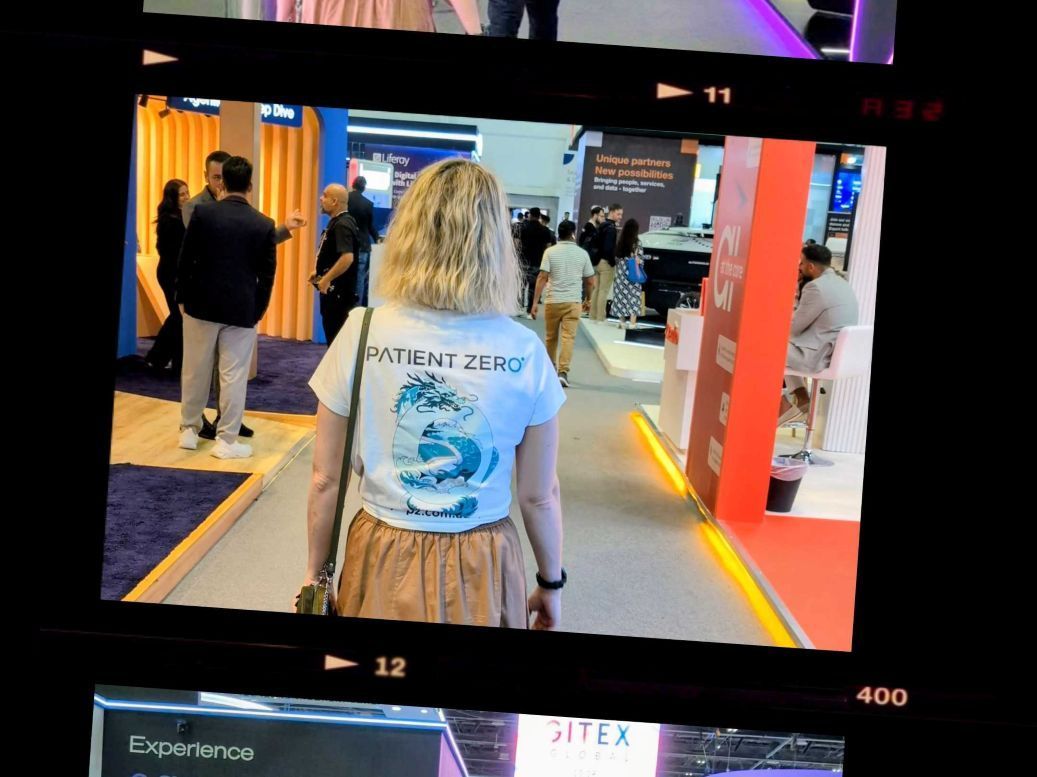
Apart from the legendary Patient Zero merch roaming the halls, Australia’s presence was tiny. Two companies exhibited, and the only one I recognised was Espresso Displays, whose portable screen I swear by. Not even Atlassian or Canva had a lookin, two of our biggest tech successes. Every other country seemed to have a footprint; Moscow, Pakistan, Turkey, Poland, Latvia, Serbia… you name it. Not Australia.
In a world where technology is the new frontline of national security, our absence wasn't just embarrassing; it was a strategic vulnerability. While other nations are aggressively exporting their sovereign capability, we seem content to just import theirs.
The Verdict: Innovation vs. Stagnation

Dubai and the UAE genuinely feel like the future. The Museum of the Future itself looks like it was dropped in from another timeline. Digital displays everywhere. Flying taxis and autonomous vehicles looming.
Meanwhile, Australia’s pace in the innovation race feels more snail than hare.
The world is moving fast. We have the talent and the money (clearly) to compete. We just need to stop admiring the problems and start engineering the solutions. It's time to catch the flight.
Where to From Here?
We believe that tools are not skills. If you are tired of the "AI Slop" and want to build workflows that actually scale, we can help you engineer the solution.
- App Modernisation: See how we rescue legacy systems from technical debt.
- Embedded Teams: Hire the people who know how to wield AI.
- Co-CEO Series:
Watch what happens when AI becomes your fourth Co-CEO.
Join the Conversation

Demelza Green is the Co-CEO of Patient Zero and 10,000 Spoons. A Women in Digital UX Leader of the Year and ARN Innovation Award winner, she sits at the intersection of human experience and technical reality. She believes that while tools change, the fundamentals of good design and engineering rigour never go away.
Her goal? To help Australian businesses stop admiring the problem and start building the solution.
Share This Post
Get In Touch
Recent Posts