
The Team Exercise That Exposes Broken Communication in 20 Minutes
EDITOR'S NOTE
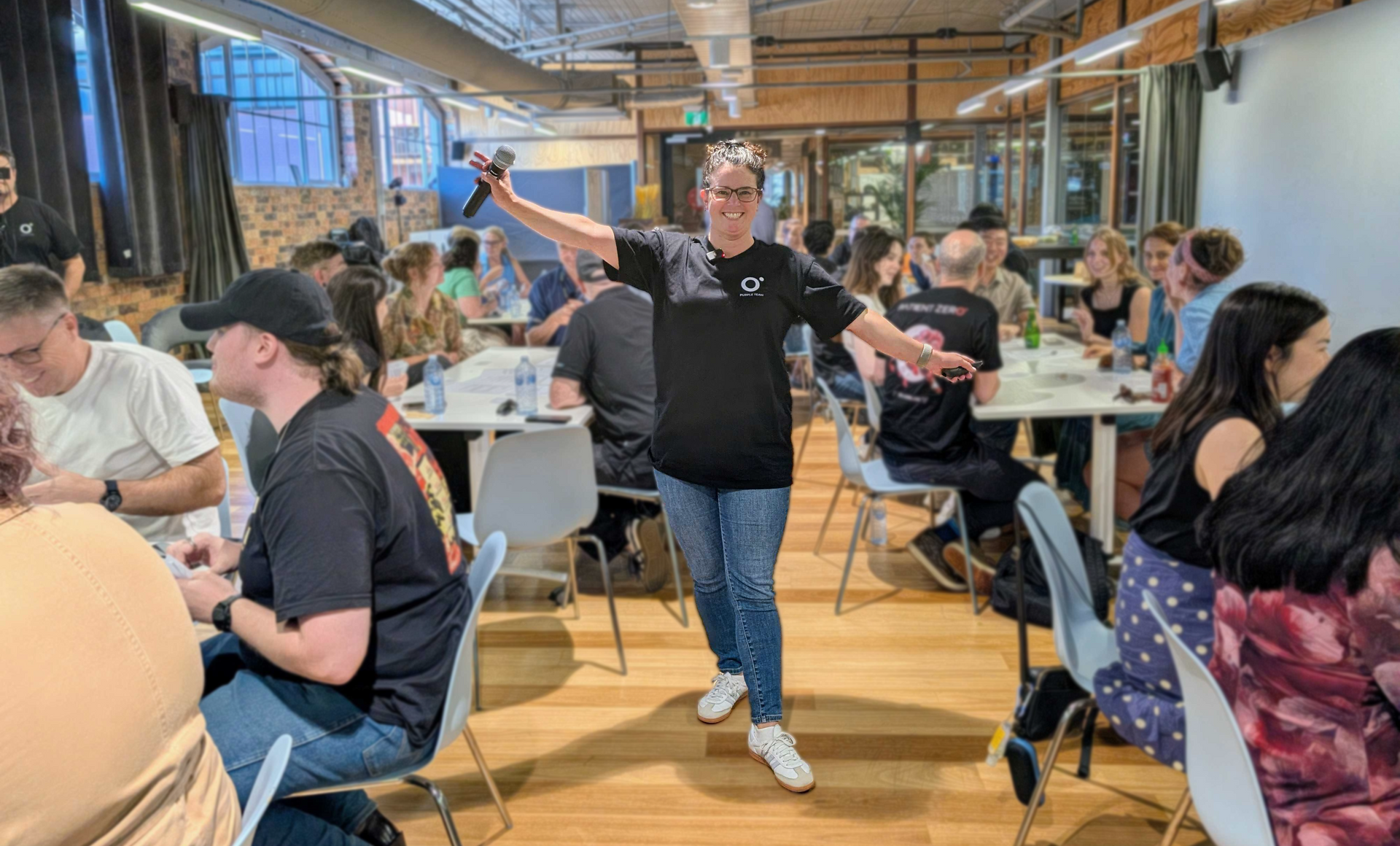
Jacinta Streat, Patient Zero's Principal Evangelist - so called because she is fanatical about continuous improvement culture - recently ran a 30min game with PZer's. Who knew a simple game could have such a big impact? It surfaced how language, context, participation, and momentum really work inside teams: why new starters struggle, why progress isn’t always linear, and why teams sometimes slow down before they speed up. This article explains the game, the takeaways, and how you can run it yourself.
(TL;DR)
- The Game: Teams 'deliver' by guessing card identities using descriptions, single words, and gestures over three rounds. The same cards repeat each round to create a shared shorthand.
- The Aim: The game lets teams experience (and reflect on) collaboration, context, and dynamics first-hand in a low-stakes environment - learning through shared play is far more effective than slides.
- The Insight: The unique experience each person brings to a team is made visible, and players realise that when someone disengages, the whole team loses capability.
- The Pattern: The game reveals how teams develop through stages. Starting a new project resets shared language and rhythm, but with the right ways of working, teams can regain flow quickly.
A Simple Game that Exposes Real Team Dynamics
At Patient Zero, we’re always looking for ways to help teams work better together. One of the most powerful ways to do that is surprisingly simple: play a game.
Why? Games strip away hierarchy, expose team dynamics instantly, and create shared language faster than any slide deck ever could. I designed, a workshop based on the game Monikers, a fast, funny, slightly chaotic experience that helps teams remember what it feels like to form a team and recognise the stages of team development.
The Game: Form teams of around 4-7 people, each with a set of Monikers cards. The game is played in three rounds using the same set of cards each round. Each team member takes a turn at 'explaining' the characters on the cards - think Free Willy, Crocodile Dundee, Siri - while the rest of their team tries to guess it.
But of course, each round it gets harder. In Round 1, you can say anything except the word itself. In Round 2, you may only say one word. In Round 3, you must act out the clue without any words. At this point, you will see some gestures and hear some sound effects that make you question your teammates sanity. But there will also be A LOT of laughter. Because the pool of cards remains identical each round, players rely on shared memory and increasingly absurd shorthand to identify the answers. The team with the most correct guesses at the end of the final round wins.
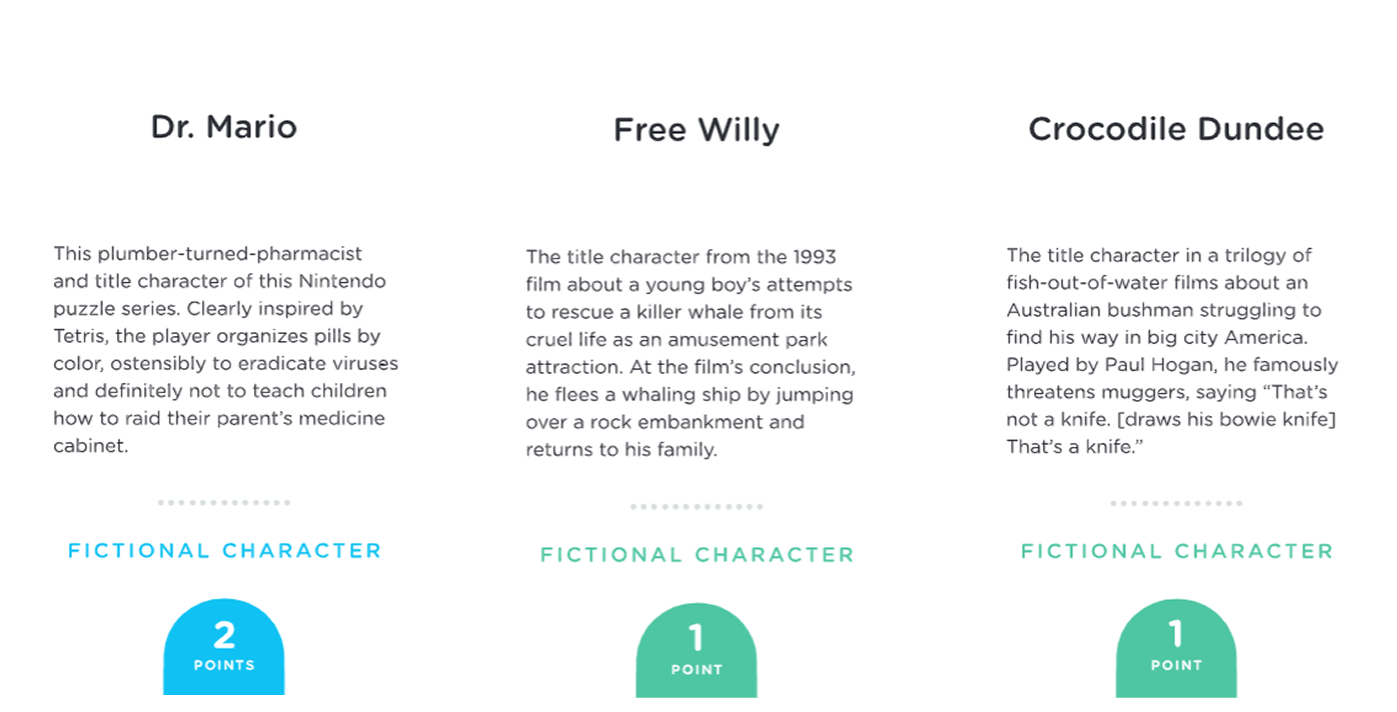
Above: Sample cards from the Monikers deck
Takeaway 1. Everyone Brings Hidden Knowledge
During set up, the team's deck is divided equally amongst players. Everyone gets 2 minutes to quickly scan these cards before shuffling them all back together. This means everyone has knowledge about some of the deck, but not all of it.
Bam! Timer starts. You pick up a card, you start saying “Lives in the ocean...”, someone yells “Free Willy!”. So many things live in the ocean.... you wonder how did they get that so fast?
Next card. “He is the star of a Nintendo game and has a red hat...”, the PZ resident gamer shouts “Mario!”. Who knew your teammates were into gaming?
And so on. By the end of round 1, three of your cards were guessed correctly before you even finished your clue!
Reflection Question:
Did you learn anything about your teammate’s knowledge that surprised you?
The correct answers come from 2 places, one is the knowledge about part of the deck players are given in the set up; someone already knew Free Willy was in the pack. The second source is the unique player themselves; the PZ gamer is primed to associate red hats with Mario. That familiarity is just like the experience each person brings to a team. Everyone has pockets of knowledge, niche interests, and lived experience that can help the group - if they feel safe enough to share it.
The game manufactures a feeling of safety; it’s supposed to be fun and it’s ok to fail because there are no real stakes. But this highlights the importance of creating an environment where everyone will share their knowledge. When people feel comfortable speaking up, it leads to better teamwork, richer ideas, and fewer missed opportunities. One of the saddest things is when a team member has underutilised talent. So, tap into what your teammates know and help bring out the best in them. Their experience is part of your team’s advantage.
Takeaway 2. Teamwork Only Works When Everyone Participates
Have you heard of “Lay Down Sally”, the Aussie rower who stopped rowing during the 2004 Olympic finals? The team went from vying for a medal to coming dead last. One person sitting out can change everything.
The game reinforces this message. The set-up gives each player information about some of the characters in the deck. In the first round, they are the only person with that knowledge. Players quickly realise that information is invaluable for fast and accurate guesses.
Reflection Question:
Did your team need every member to participate? Why?
If someone doesn’t participate, the team loses access to that player’s knowledge of the deck – and the team’s chance to score.
Delivery teams are no different.
When someone disengages, the whole team loses capability.
Takeaway 3. Lost in Translation: Corporate Edition
Ever joined a team halfway through a project? Started a job in a new industry? By the end of day one you’re left thinking: What on earth are these people saying? Between the jargon, acronyms, and in‑jokes, they may as well be playing charades.
I first played this game at the pub and onlookers thought it looked boring, it was a card game after all. But when they came back an hour later, we were cacking ourselves, acting out clues with wild gestures. They couldn’t believe how we were guessing the cards so easily.
The same thing happened at PZ - by round 3 no one was using words, everyone was in stitches and they were getting almost every card right!
Reflection Question:
If someone joined your team in Round 2 or 3, how many cards would they guess correctly?
If you only join this game in round 3, it’s almost impossible to guess a card correctly. Everyone else has built shared context (references, shortcuts, inside knowledge) that you just don’t have. It’s exactly what it feels like to join a team in sprint 20.
New joiners aren’t slow, they’re missing context. When you notice someone missing context don’t assume they’re not paying attention, remember they started in a different round. Try implementing a system to get them up to speed.
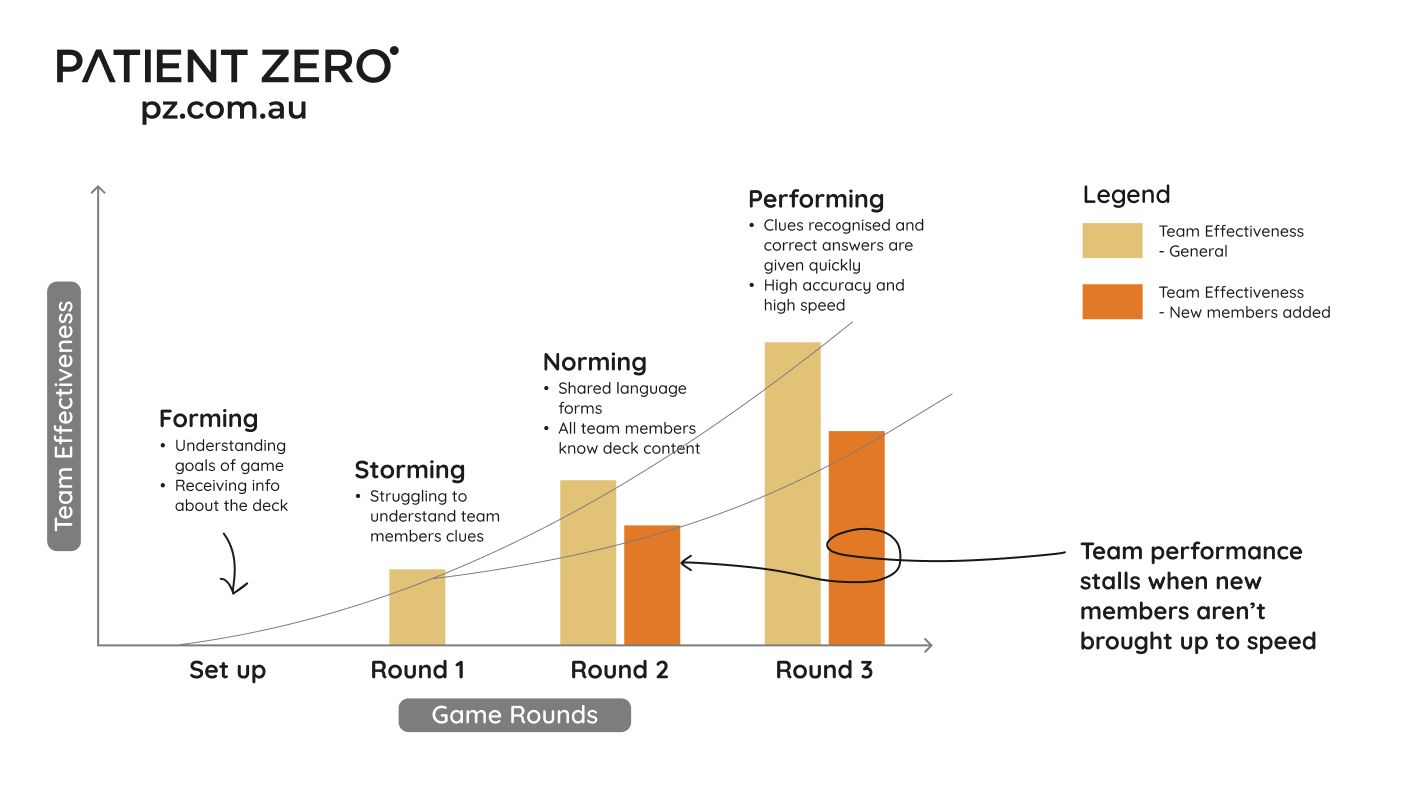
Above: Diagram showing Tuckman's Team Stages mapped onto the team effectiveness in each round of the Moniker's game
Takeaway 4. Comparison Kills
Ever caught yourself comparing your progress (or your team’s) to someone else’s? My gym coach said if everyone wore a number above their head showing how many sessions they’d attended, you’d stop comparing your 25th class and your wobbly pull-up, to the person effortlessly doing bar muscle-ups in their 1,587th. Context changes everything.
The same thing happens in the game.
Reflection Question:
Would it be fair to compare a Round 3 team to a Round 1 team?
In rounds 2 and 3, even though the rules technically make it harder, teams usually guess more cards correctly. Why? Because they’ve learned from every round to build a shared language.
That’s why comparing team velocity is meaningless. You need to think about their “training age”. Some teams will be in Sprint 0 setting up at a client (like Round 1) and others will be in Sprint 47 (like Round 3).
Takeaway 5. New Deck = New Work
Ever started a new project and felt like all your momentum disappeared? It’s like finishing the bike leg of a triathlon and then trying to run, your legs turn to jelly for the first 500m while your brain wonders who signed you up for this!
The game makes this dip visible.
Reflection Question:
What would happen if you were given a brand‑new deck in Round 3?
Every new piece of work is like picking up a fresh Monikers deck. The rhythm, the flow, the shared language, it all needs a moment to rebuild.
Don’t get disheartened by that temporary slowdown. At PZ, we’ve built ways of working that help teams get work ready quickly, so the “jelly legs” phase is short and the momentum comes back fast.
Why This Game Sticks
Teams don’t remember slides.
They remember feelings, moments, and metaphors that make invisible dynamics visible.
This game does exactly that.
It helps teams:
- Build shared language
- Understand context gaps
- Appreciate each other’s strengths
- Recognise the importance of participation
- Normalise the dip when starting new work
And most importantly, it gives them a shared experience they can reference for years.
Run The Workshop Yourself
Workshop Run Sheet (30 minutes)
Introduction & Setup — 5 mins
Play the Game — 15 mins
Round 1 — 2 mins + scoring
Round 2 — 2 mins + scoring
Round 3 — 2 mins + scoring
Learning & Reflection — 10 mins
To run a longer workshop, simply extend the round times and increase the number of cards in the deck.
Setup Before the Workshop
- Arrange tables classroom‑style (4–7 people per team).
- Create a deck of Monikers cards (4–5 cards per person).
- Print the game objectives and round rules for each table.
- Screen the cards if you’re running this in a workplace — some aren’t PC.
How to Play
Your Task
You are a delivery team. Your goal is to guess the identity of as many cards as possible. Ignore the points printed on the cards. (The full monikers game adds up the points but to keep it simple 1 card = 1 point)
Setup
- Form teams around a table.
- Nominate a dealer.
- Deal an even number of cards to each person.
- Read your cards quickly — you only have two minutes.
- Shuffle all cards back together and prepare for Round 1.
- There are three rounds, each with different rules. See Round Rules below.
- Each round lasts two minutes.
- Team members take turns giving clues.
- Skipping is allowed and encouraged.
- Keep correctly guessed cards in a pile for scoring.
- Shuffle all cards together after each round.
- The team with the highest total after three rounds wins.
Round Rules
Round 1
Use any words, sounds, or gestures except the name itself. If you say any part of the name, you must skip the card.
Round 2
Use only one word (not the name). You can repeat it as many times as you like. Gestures and sound effects are allowed.
Round 3
Charades only. No words. Sound effects allowed (encouraged).
Skip the Setup. Start at Round 3.
Want to experience "Round 3" team performance from day one? Our embedded teams arrive with a shared language and technical excellence to drive your projects forward with immediate speed.
- Learn more about how we position our embedded teams for success within your organisation.
- See how we helped a start up develop ways of working so they could scale up.
- Think you've got what it takes to be a PZ team player? Check out what it's like to work at Patient Zero.
About The Author

Jacinta Streat is the Principal Evangelist at Patient Zero with years of experience bridging the gap between technical and business domains and driving continuous improvement.
She enjoys mastering gym skills like handstand push ups and celebrating personal bests on the golf course.
