From Inspector Gadget to James Bond: Why Agentic AI Needs "Spec-Driven Development"

EDITOR'S NOTE
At Patient Zero, we believe the future of software capability isn't just about coding faster; it's about architecting better. As AI shifts from simple chatbots to autonomous "Agents," the risk of "spaghetti code" multiplies. This article encapsulates our philosophy of building maturity over just renting capacity. By enforcing Spec-Driven Development, we ensure that Sovereign AI serves the mission, not the other way around.
(TL;DR)
The Problem: "Vibe Coding", blindly prompting AI agents, is creating chaotic, "Inspector Gadget" style software that is prone to hallucinations and lacks architectural integrity.
The Solution: Spec-Driven Development (SDD). A methodology where you define a strict "Architect’s Blueprint" (Specs) and a "Constitution" (Rules) before letting AI write a single line of code.
The Tools: Hanieh Madad (Principal Software Engineer, Patient Zero) compares AWS Kiro (an integrated Agentic IDE) vs. GitHub SpecKit (a flexible, tool-agnostic workflow).
The Takeaway: To move from chaos to precision (James Bond style), humans must define the "What" and "Why" (Context), while Agentic AI executes the "How".
The Hook: Escaping the "Vibe Coding" Trap
We are living through a shift from Generative AI (Chatbots) to Agentic AI (Autonomous Workers). Developers are no longer just asking a bot to write a function; they are deploying agents to build entire features.
But as Hanieh Madad, Principal Software Engineer at Patient Zero, explained at DDD Brisbane 2025, this new power brings new risks. Without structure, Agentic workflows often resemble Inspector Gadget: enthusiastic and loaded with tools, but clumsy, reactive, and prone to spiralling into chaotic loops.
"Vibe Coding", where you blindly prompt an agent and hope for the best, might work for a prototype, but in an enterprise environment, autonomous agents without guardrails are a liability.
For sovereign, scalable software, "Inspector Gadget" isn't good enough. You need James Bond: intentional, precise, and mission-focused.
The control plane that makes this possible is Spec-Driven Development (SDD).
What is Spec-Driven Development (SDD)?

SDD is a methodology that brings engineering rigor to Agentic AI. It is a direct response to the limitations of "Vibe Coding," where AI assistants lose context, hallucinate details, and drift from the original intent.
Instead of telling an agent to "build a website," SDD centres the workflow around a structured Specification. This turns high-level ideas into detailed implementation plans before the agents are unleashed.
It flips the script on the last decade of software engineering:
- The Old Way: Code is King. Write code first, then maybe document it later.
- The Agentic Way: The Spec is King. Define the requirements, the design, and the guardrails first. Then, and only then, do you authorise the agents to build against that blueprint.
This isn't about bringing back "Waterfall." It is about giving autonomous agents a clear "Mission Profile" so they don't go rogue.
The Landscape: Two Approaches to Controlling Agents
The market is being flooded with "Autopilot" tools. However, most are non-deterministic, if you ask an agent to solve a problem twice, it might solve it differently both times.
In her demonstration, Hanieh highlighted two pioneering tools that solve this by forcing structure onto the agents. She chose these because they represent the two distinct philosophies of Agentic implementation:
1. The Integrated Platform: AWS Kiro (The Agentic IDE)
AWS Kiro is an "Agentic IDE", essentially a fork of VS Code with a multi-agent system baked into the core. It doesn't just autocomplete code; it spins up different agents for different tasks (Planning, Coding, Testing).
How it enforces maturity:
- Hooks: Kiro allows teams to define automated triggers. For example, you can set a "Hook" that forces an agent to write tests every time it saves a file.
- Steering: This acts as a set of system prompts for your agents. You can define global steering rules (like "Always use Version Control" or "Check for Security Vulnerabilities") that apply to every project. This effectively creates a "Governance Layer" that the agents cannot bypass.
2. The Flexible Toolkit: GitHub SpecKit (The Agnostic Tool)
On the other end of the spectrum is GitHub SpecKit. Unlike Kiro, this is an open-source toolkit that is "IDE Agnostic". It allows you to bolt an Agentic workflow onto your existing tools.
How it enforces maturity:
- The Constitution: SpecKit asks you to define a "Constitution", a set of non-negotiable rules and principles for the project. The agents must check this constitution before generating any code, ensuring they adhere to your architectural standards.
- Phase-Based Execution: Instead of trying to do everything at once, SpecKit breaks the agent's work into clear phases (Spec, Plan, Task, Implementation). This prevents the agent from getting "distracted" and keeps it focused on the immediate mission.
Strategic Alignment: Building Maturity, Not Just Capacity
At Patient Zero, our mantra is: Stop renting capacity, start building maturity. SDD is the technical manifestation of that philosophy. We don't just use Agentic AI to code faster (capacity); we use it to architect better (maturity).
1. The Architect’s Blueprint
SDD treats the specification as the "Architect's Blueprint". By generating Requirements, Design, and Task markdown files first, we force the AI (and the human) to think about the system architecture before writing code. This prevents the "spaghetti code" that often comes from unchecked autonomous loops.
2. Documentation as a Living Artifact
We all hate writing documentation. With SDD, the documentation is the prompt. The Requirements file drives the agent's behaviour. This means your documentation never drifts from reality, it remains the living source of truth for any developer joining the team.
3. Guardrails for the "Weird Creative"
Agentic models are powerful, but they can be "too ambitious" or "too eager," sometimes rushing to a solution that introduces vulnerability. By using SDD, we put guardrails in place. We ensure that the agents are not just creative, but compliant with our architectural standards.
The Bottom Line: Enablers, Not Magic
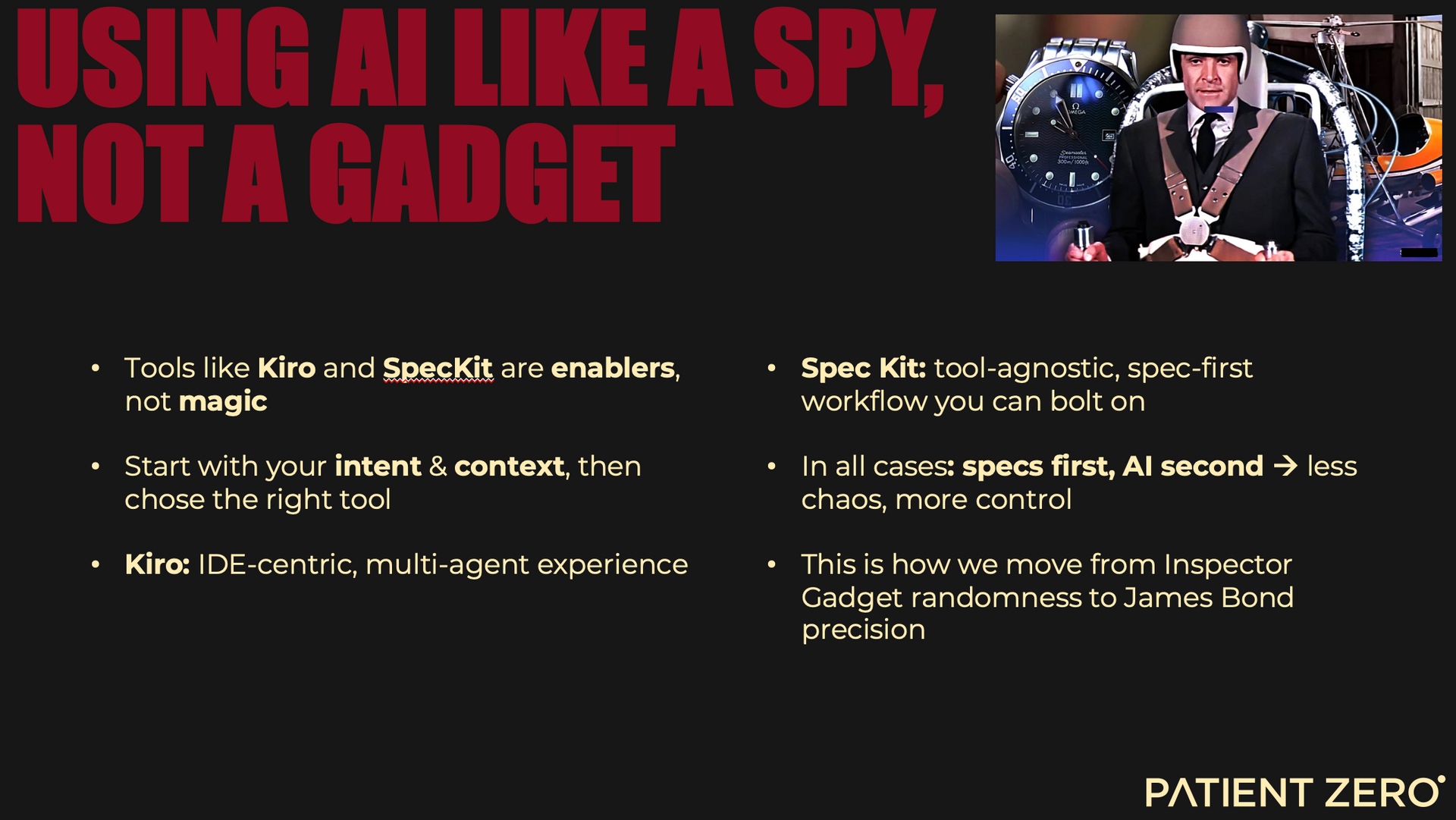
As Hanieh emphasised in her closing remarks, we must remember that tools like AWS Kiro and GitHub SpecKit are enablers, not magic wands.
Whether you choose Kiro for its deep, multi-agent IDE integration, or SpecKit for its tool-agnostic flexibility, the rule remains the same:
1. Start with Intent. Before you deploy an agent, you must define the context. The most dangerous thing you can do is give an autonomous tool a vague instruction.
2. The Golden Rule: Spec First, AI Second. The future of enterprise engineering isn't about knowing how to write syntax; it's about knowing how to define value.
- Humans define the "What" and the "Why".
- Agentic AI executes the "How".
By adopting Spec-Driven Development, we move away from the chaos of random prompting and toward a future of intentional, architectural precision. We stop being Inspector Gadget, and we finally become James Bond.
Disclaimer: This article reflects the technical reality as of December 2025. In this industry, the shelf life of information is measured in weeks, not months. Any advice, tool, or benchmark mentioned here may have already evolved or been replaced by the time you read this.
Explore Our Capabilities
Ready to move from "Inspector Gadget" chaos to "James Bond" precision? Here is how we help enterprises build maturity.
- Embedded Software Teams Stop renting capacity. Deploy complete delivery teams that plug directly into your environment to build sovereign software capability. View Our Embedded Model
- Enterprise AI & Agentic Solutions Move beyond chatbots. We build secure, sovereign Agentic AI workflows that adhere to strict governance standards, turning "Inspector Gadget" experiments into production-ready capability. Explore Our AI Services
- Application Modernisation Is your legacy code holding you back? We rescue stalled projects and refactor "spaghetti code" into scalable, future-proof platforms. Modernise Your Stack
Related Content

Inside Certember: How We Turned "I Don't Have Time" Into a Company-Wide Challenge
We all have that one certification we’ve been meaning to get. We bookmark the Udemy course, buy the exam voucher, and promise ourselves we will study "when things quiet down."

Sovereignty, AI Agents, and the End of SaaS: The CIO’s Guide to 2026
To stay ahead of the curve, Patient Zero maintains a relentless pace of global engagement.
Share This Post
Get In Touch
Recent Posts