Experience vs. The Exam: How I Passed PSPO With (almost) Zero Study

EDITOR'S NOTE
At Patient Zero, we don't just rest on our years of experience; we test them. As part of our internal "Certember" initiative, we challenged our senior team to see if their battle scars actually aligned with the textbook definitions. Here is what happens when Bay McGovern, Principal Product Owner, pits 11 years of real-world Agile experience against a rigid 60-minute exam.
(TL;DR)
- The Challenge: Can a Senior Product Owner pass the PSPO I exam with zero study, relying only on 11 years of experience?
- The Hack: Using a specific AI prompt (included below) to simulate the "Scrum Mentor" persona for rapid-fire practice.
- The Verdict: Passed (88.8%).
- The Lesson: Scrum Certifications test your ability to navigate linguistic traps;
Real-world Product Management requires the intuition to know why the answer matters. This is the difference between a "Ticket Waiter" and a true
Technical Product Owner.
Do tech certifications test real-world experience?
Or to put it in more concrete and personally relevant terms, could I pass the PSPO Certificate 1 certification on the strength of my 11 years of Agile experience, and with no study?
It’s an interesting question, and, not gonna lie, I was tempted to try. With close to 20 years tech experience (showing my age here) how hard could it be?
The Motivation (And The Free T-Shirt)
At university, I was a studious and methodical rule follower when it came to study, with rigid hours and procedures in place to ensure my grades stayed above average (without shooting for straights 7s, which IMO is a waste of time and energy – who needs to last 5%?)
However, university was a long time ago, and this time around I was spurred by different motivations. In addition to proving or disproving the validity of the PSPO certification against real-world experience, and possibly also calling into question the whole tech certification game, there was also a free T-shirt on the line if I got my cert.
Did the possibility of a free t-shirt cause some unwarranted rashness?
Maybe.
Was I going to do it anyway?
Probably.
The said shirt was part of a PZ initiative, Certember, spearheaded by none other than superstar PZ developer Hanieh Madad. As you may be able to tell by the name, Certember was supposed to happen in September.
Maybe I could push the boundaries of believability and claim I thought it was November... but January? Certanuary really doesn’t have the same ring to it.
So, I was late, I was gunning for a shirt I probably didn’t deserve, and I had no plan.
The Strategy: AI as the Tutor
Enter Product Owner Kei Nakayama with a set of prompts she used to study via AI and pass the cert a week or so earlier.
I thought to myself, YES, I can do this, I too can use AI to teach me about my own job, and pass with flying colours.
(Or, maybe just pass, save the colours for later).
Here’s the initial prompt I went with (mostly stolen from Kei – but imitation is the highest form of flattery, right?)
I want to pass my Professional Product Owner exam (here is some suggested reading: https://www.scrum.org/resources/suggested-reading-professional-scrum-product-owner).
This is the scrum guide that most of the questions are based on: https://scrumguides.org/docs/scrumguide/v2020/2020-Scrum-Guide-US.pdf
For my PSPO 1 exam, based on the Scrum Guide provided, please act as a Scrum Mentor. Give me 10 challenging multiple-choice questions.
Constraints: Focus on the accountabilities of the Product Owner versus the Scrum Master and Developers.
Do not ask for definitions. Ask what a PO should do in a specific situation
Do not give me the answer until I respond. Make the wrong options look very tempting.
After I answer, explain the why behind the correct choice under the Scrum Guide Logic and why not for the incorrect answers.
Keep the tone encouraging but professional
Within a few minutes, I was doing practice test questions and scoring 13/15, 20/20, 18/20 and so on. Each set of questions seems easier than the last. I asked for harder questions, and still my results were a few percentage points away from 100%.
I put in a massive half hour of study that first day. Phew.
A "Scrum Master" False Start
The next day I asked for more, and spent another INTENSE half hour feeling very excellent about myself and my amazing knowledge of being a product owner. I thought, f*ck it, I’m just going to go for it. So I headed to the scrum.org website and bought the test.
As I hit the purchase button I got the awful feeling that maybe I hadn’t properly checked which certification was in my cart before blithely clicking the purchase button. With a rising sense of panic I went to my mailbox only to see I’d made my first mistake… I’d bought the Scrum Master Certificate I.
Which I already have. Excellent! Off to a winning start.
This small slip-up did make me second guess doing the test at all. If I can’t even buy the damn thing correctly, how will I pass? Luckily, after contacting scrum.org I got a refund (minus international purchase fees and a constantly changing exchange rate) and headed back to buy the correct test.
The Exam Reality: Confusion and Linguistic Traps
The test password sat in my inbox for a few days. I was… scared. I hadn’t sat a test since doing my Diploma of Business Systems Analysis at UBC in 2007. Almost 20 years later, do I have what it takes to pass a test?
The next Monday afternoon, about 4pm, with most of my work for the day done, I just decided to do it.
Don’t think, just do.
Boom! The timer starts. 60 mins for 80 questions. About 5 questions in, I started to wonder whether I had studied the wrong material. The content of the questions feels unfamiliar, and I definitely haven’t been asked these topics by my AI tutor. The questions and answers are worded confusingly. There are always one or two obviously incorrect answers, but the others are difficult to distinguish between.
I messaged my fellow POs mid-test to tell them that I think I’m going to fail (they all had so much confidence in me), but I’d rather tell them sooner that I’m an utter loser.
Another thing about me is that I’m not a second-guesser. Once I’d completed a question, despite having no confidence in my answer, I simply moved on and forgot about it.
So, when I got to the 80th question, 30 minutes in, and saw the submit button, my cursor only hovered momentarily before I pressed it and sent a prayer to the universe. Please scrum gods, if you do exist, which I’m certain you do, please let me pass this test!
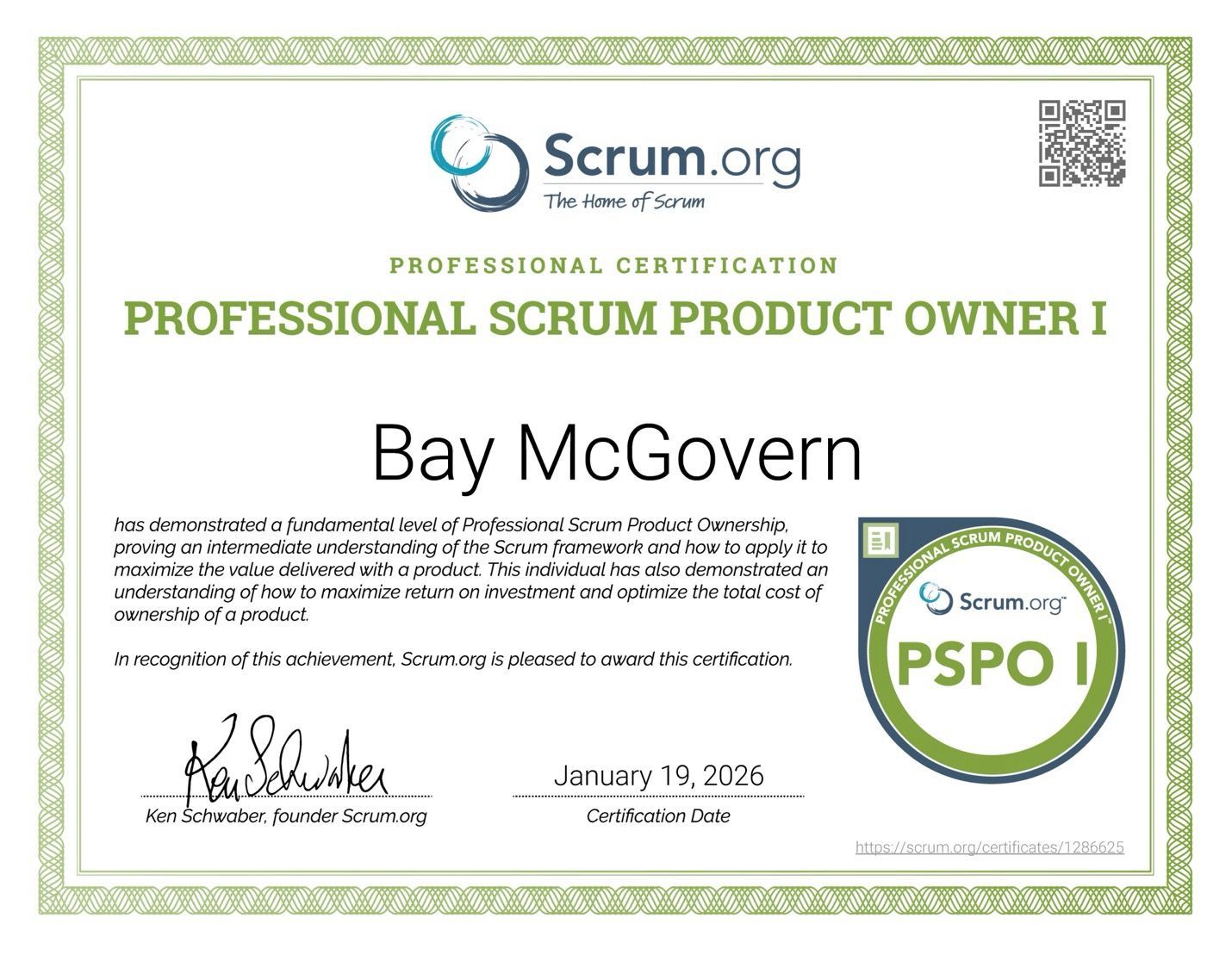
I checked my inbox and, thank goodness, I passed, 88.8%. Which, if we’re going to get into particulars, would be a high distinction in the old scale. Just saying. (Tho 85% is the passing grade for the PSPO cert, talk about a high bar!)
The Post-Mortem: Why Experience Won
After the initial ecstasy of passing subsided, a few questions came to mind.
- Did I study enough?
- Were the questions and answers really so confusing?
- Did I study the wrong materials, or miss some content?
- Would I have passed the exam without my years of experience?
I decided to ask my AI teacher for their expert opinion.
I didn’t ask AI question one, as I think we all know the answer to this would be a resounding NO. I definitely did not study enough.
Here is what they said for the rest.
- Yes, the scrum.org tests are notorious for containing linguistic traps (that made me feel a little better).
- Yes, I should probably have read (or at least understood the fundamentals of):
- The Evidence-Based Management Guide
- The Agile Manifesto (which I do know something of)
- The Professional Product Owner book (unofficial textbook for the test)
- Maybe… experience can be a double-edged sword. You may inadvertently focus on the way you CURRENTLY do things instead of the way you SHOULD do things. If you do the former, you are unlikely to pass the test.
So what’s my takeaway on this whole experience?
Since I managed to pass, I wouldn’t do anything differently. But my personal opinion is that, after years of working in organisations attempting to do things the right way (and often failing), I was pretty clear on what the theoretically correct way of doing things was. And, I would have been unlikely to pass the exam on so little study without this.
The Verdict: Rules vs. Intuition
It also got me thinking about the value of certs in general. Apart from wanting to prove something to myself and the rest of the world (which may place a higher value on these things than I do), did I learn anything?
I'd say I definitely scrubbed up on some of the finer points of scrum product management and can use them more confidently in conversations, rather than just following my intuition. But I also feel like rigidly applying these rules without context is a path to failure. You must know the rules and have real-world experience to know when to break them effectively.
In the end, did I prove that tech certifications are bullshit? Or, did I prove that I genuinely know how to do my job? Who can say? All I know for sure is that I’m looking forward to getting my sweet Certanuary Certember shirt.
Need a Product Owner who knows the difference?
A certificate proves you know the theory. A partner proves you can handle the reality.
- The Team: Don't hire a "ticket waiter." Get a Product Owner like Bay who drives outcomes with our Embedded Capability Uplift.
- The Strategy: Avoid the "Feature Factory" trap. Define a roadmap that actually delivers value with Strategy & Discovery.
- The Career: Think you could pass the test with zero study? We are always looking for senior talent. Check out what it's like to work at Patient Zero.
About Bay McGovern

Bay McGovern is a Principal Product Owner at Patient Zero, where she herds cats, defines roadmaps, and passes exams on sheer intuition.
With nearly 20 years in tech and 11 years specialising in Agile delivery,
Bay has seen every flavour of "Scrum-ish" there is. A WIICTA Finalist for Achievement, she is known for cutting through the methodology noise to focus on what actually ships product.
Learn more about Bay and her full journey from Vancouver to Brisbane in Meet Bay McGovern.
Share This Post
Get In Touch
Recent Posts